It usually starts on the kitchen table: a laptop, headphones and a keyboard that gets packed away every time someone wants to eat. Then come the speakers, an interface and a nest of cables, and the whole lot moves to a desk in the bedroom. Now the speakers sit at chest height, the keyboard hangs off the edge, and the power strip lives under your feet.
Somewhere in your head there’s a picture of the studio you’d like: speakers at ear height, a keyboard that slides away, a place for everything. This guide is about the desk that gets you there: what it does that an ordinary desk can’t, what to measure first, and the best studio desk at each budget, from under $300 to the kind you’d find in a professional studio, plus picks for a small room and for 88 keys.
Do you need a studio desk?
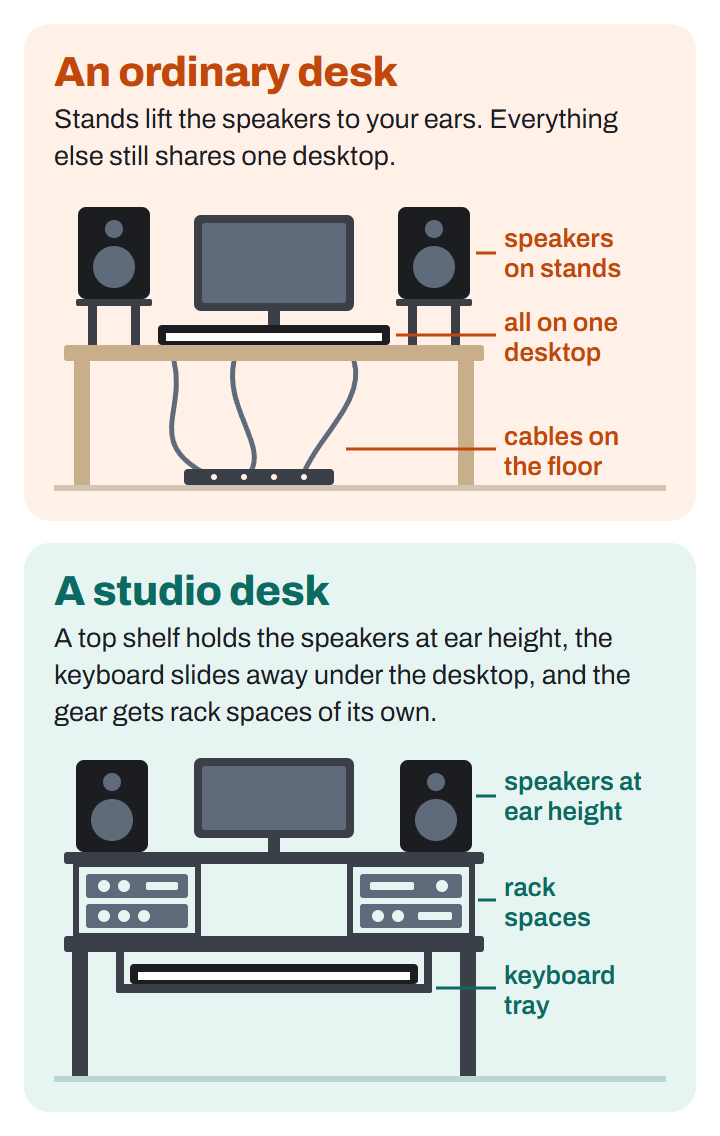
Not to start. Plenty of good music has been made on a kitchen table, and a sturdy ordinary desk will do the job for a long time, as long as you sort out the one thing it can’t: your monitors. On a plain desk they sit too low and often too close to the wall, so they need stands or pads to get the tweeters up to your ears. That fix costs far less than a new desk, and our guide to setting up studio monitors on a desk shows how.
A studio desk starts to earn its price when your gear stops fitting. A raised top shelf puts the monitors at ear height without a stack of books. A sliding tray under the desktop holds a keyboard where your hands want it, with the computer keyboard and mouse above. Rack spaces give an interface, a preamp or a power strip a home of their own, and a channel at the back hides the cables.
And yes, part of it is how the room feels. A desk built around your gear turns a corner of a bedroom into a place you want to sit down and make something. That’s worth something too, as long as it’s the last thing you buy, not the first.
What to measure first
Studio desks arrive flat-packed and heavy, and nobody wants to haul 80 pounds of boxes back to the post office. So get out a tape measure first.
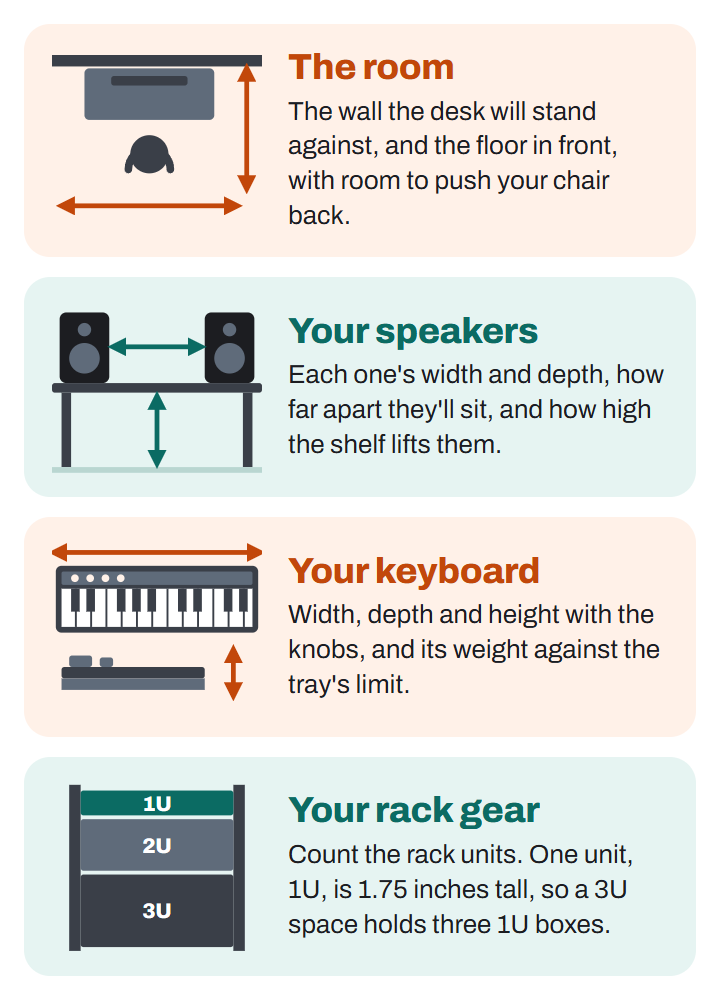
The room. Measure the wall the desk will stand against, then the floor in front, leaving room to push your chair back. Speakers are happiest near the wall behind them and away from corners, so plan on a wall, and on the middle of it if you can.
Your speakers. The top shelf has to hold both, about an arm’s length apart, so check their width and depth against it. Every shelf in this guide sits 36.7 to 40 inches off the floor: add the distance from the bottom of your speaker to its tweeter and compare that with your ears as you sit. If it falls short, pads or stands make up the difference.
Your keyboard. “Fits 61 keys” doesn’t promise your 61 fits: keyboards with the same number of keys come in different widths, and knobs add height. Check its width, depth, height and weight against the tray. Weight matters most at 88 keys, where hammer-action keyboards are the heaviest. Our best MIDI keyboard for beginners gives sizes and weights.
Your rack gear. Rack space is counted in units: one unit, 1U, is 1.75 inches tall, so a 3U space takes three 1U boxes. Most beginner interfaces have no rack ears and live on the desktop anyway, so count what you have, add one for what’s next, and see how to rackmount studio gear for the rest.
The picks at a glance
| Best for | Our pick | Size (W x D) | Rack space | Keyboard tray | Price |
|---|---|---|---|---|---|
| Under $300 | On-Stage WS7500 | 43 x 32.5 in | None | Computer keyboard | $297.95 |
| Under $600 | Gator Frameworks Content Creator Desk | 43 x 36.5 in | 3U | Computer keyboard | $359.99 |
| Under $1,000 | Gator Frameworks Elite Desk | 47.2 x 30 in | 8U | 49 keys | $629.99 |
| Small rooms | Glorious Sound Desk Compact | 40 x 25.6 in | 6U | 61 keys | $449.99 |
| 88-key keyboards | Glorious Sound Desk Pro | 61 x 25.6 in | 6U | 88 keys | $649.99 |
| Under $2,500 | Zaor Miza 88 XL Flex | 61.4 x 38.8 in | 12U | 88 keys | $2,199 |
| Under $5,000 | Zaor Onda MKII Angled | 93.5 x 35.4 in | 24U | None | $3,199 |
Best Studio Desk Under $300: On-Stage WS7500
Check the price on Amazon $297.95 when we checked
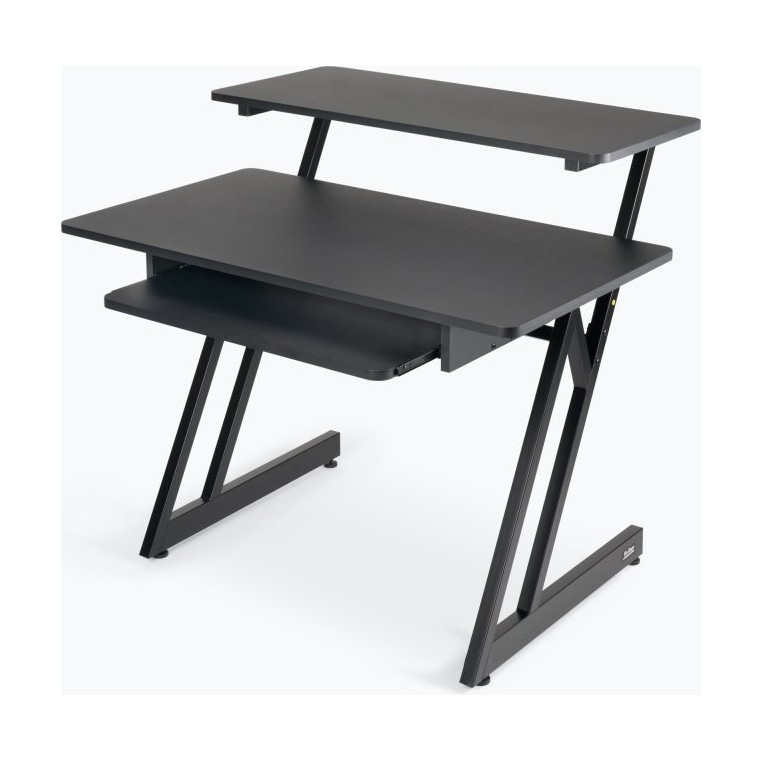
This is the desk we’d point most people to first. It’s a simple idea done well: a steel Z-shaped frame, a 43-by-24-inch desktop, a 39-by-17-inch shelf at 37.5 inches for the speakers and the screen, and a tray that slides out for the computer keyboard and mouse. On-Stage rates it for 175 pounds.
Owners like it a lot: it goes together easily and feels sturdy once it’s up, built to last. The top shelf bolts on in two positions, so you can choose more open desktop or a desk that sits closer to the wall.
The catches: the tray is 27 inches wide and made for a computer keyboard, so a MIDI keyboard lives on the desktop, which one owner wished were otherwise. There’s no rack space, and On-Stage’s matching rack cabinet costs $239.95. A couple of buyers found scratches or a dent, so check the parts as you unpack.
Under $300, it’s the one to get. If you want your MIDI keyboard off the desktop, skip ahead to the Glorious Compact.
Best Studio Desk Under $600: Gator Frameworks Content Creator Desk
Check the price on Amazon $359.99 when we checked
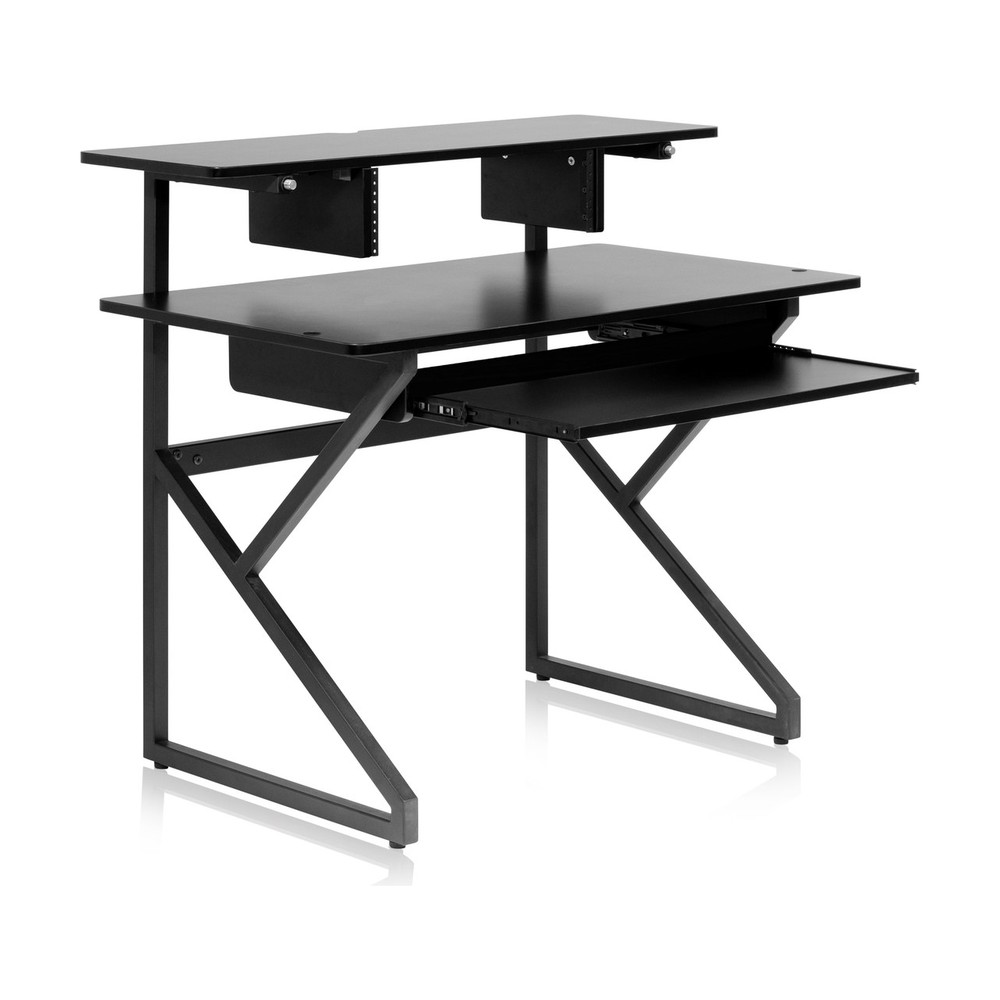
For about $60 more, Gator’s Content Creator desk adds what the On-Stage lacks: 3U of rack space under the top shelf, enough for a power strip and a preamp, and a stronger frame. Gator rates the steel frame for 350 pounds, twice the On-Stage’s figure. The desktop is 43 by 24.5 inches with a 43-by-14-inch shelf above, and there are leveling feet, plus threaded posts and pre-drilled holes for a desk mic stand or boom arm, handy if you record vocals where you sit. Gator backs it for three years.
The catches: the tray is a computer keyboard tray again, with room for a small controller at most. It also has far fewer owner reviews than the On-Stage, and they’re mixed on the build. Most owners describe a solid desk with a smooth tray, but one found no pilot holes for the screws, and another got a kit missing parts that should have been fitted at the factory. Check the box against the parts list before you start.
Buy it for the rack space and the stronger frame. If you need neither, the On-Stage does the rest for less.
Best Studio Desk Under $1,000: Gator Frameworks Elite Desk
Check the price on Amazon $629.99 when we checked
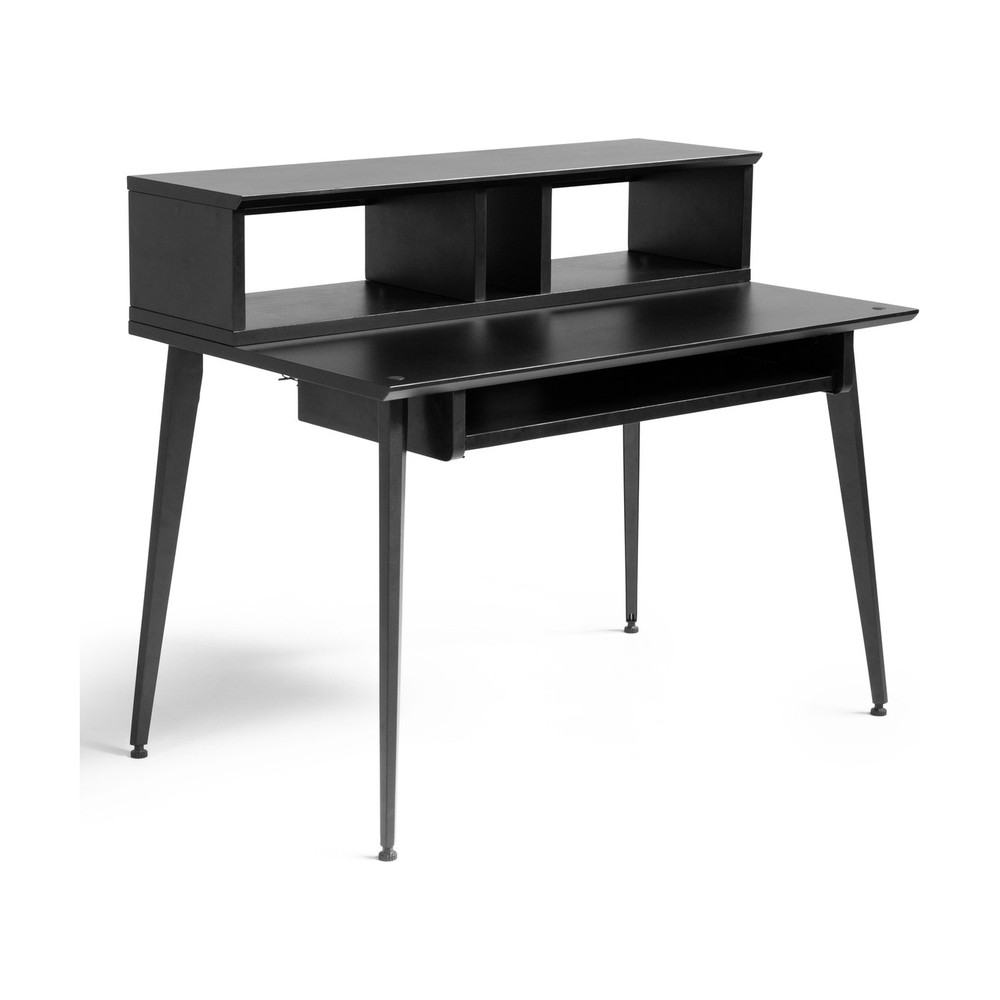
You don’t need to spend $1,000 on a desk, and this one doesn’t ask you to. Above $600 you’re mostly paying for a desk that looks like furniture rather than equipment, and the Elite does: 1-inch-thick platforms on tapered metal legs, with the cables hidden behind panels in the legs.
It’s built around the gear, too. A raised box across the back holds the speakers and screen 40 inches off the floor, with up to 8U of rack space in two 4U bays underneath, and a soft-close tray takes a 49-key keyboard of up to 35 pounds. The instructions are clear, it goes together in an afternoon with basic tools, and once it’s built it’s strong enough for years of daily use.
The catches: the lower desktop is only 17 inches deep, so a 49-key keyboard and a laptop will fill it, and the tray has 3.35 inches of headroom, so measure a keyboard with tall knobs. At 114 pounds it’s heavy, and the tray doesn’t lock when pulled out. One owner had a leg work loose after a move, when its screws tore out of the desktop, so build it where it will live.
For a desk that looks good and leaves room to grow, this is it.
Best Studio Desk for Small Rooms: Glorious Sound Desk Compact
Check the price at Musician’s Friend $449.99 when we checked
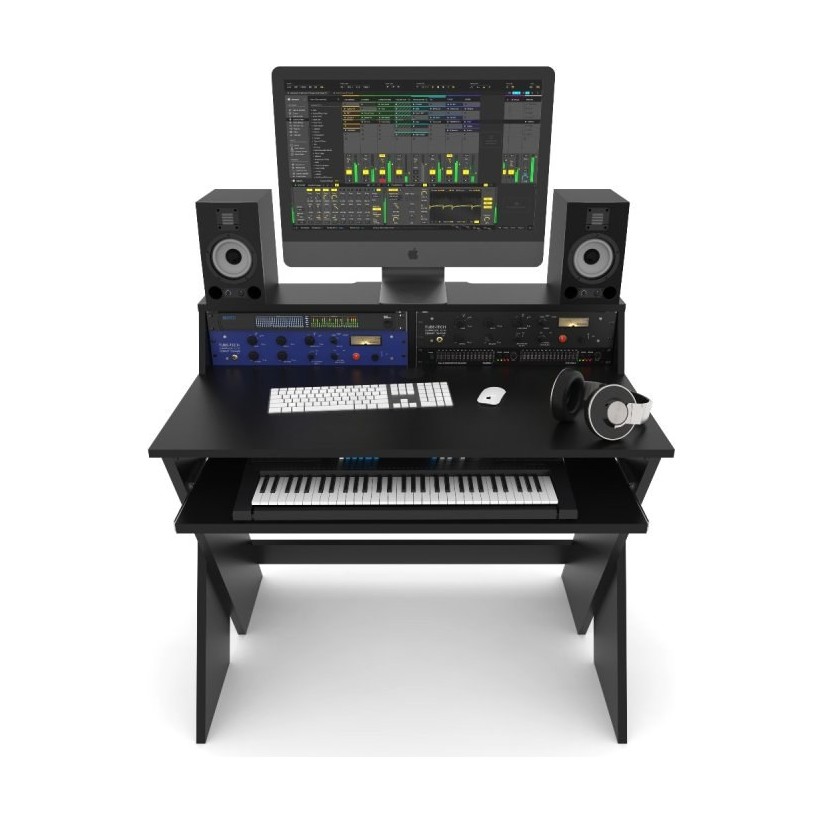
In a small bedroom every inch of wall counts, and the Sound Desk Compact gets more studio into less of it than anything else here. At 40 by 25.6 inches it’s the smallest desk in this guide, yet it works on three levels: a top shelf for the speakers and screen, two 3U racks beneath it, and a pull-out tray for a 61-key keyboard at any of six heights.
It’s the Sound Desk Pro below, cut down, with the same X-shaped frame and extra bracing, and it’s the Glorious desk made for a 61-key controller. It ships in one box under 65 pounds, which matters if your small room is up two flights of stairs.
The catches: the tray is rated for 12.5 kilos (about 27 pounds) and the desktop for 35 (77 pounds), so it’s a desk for a controller, a screen and small monitors, not a stack of hardware synths. The height doesn’t adjust. And Amazon doesn’t sell it, nor anything else with a 61-key tray and racks in 40 inches, so this one comes from music shops.
For a small room with a real keyboard in it, it’s the one.
Best Studio Desk for 88-Key Keyboards: Glorious Sound Desk Pro
Check the price at Guitar Center $649.99 when we checked
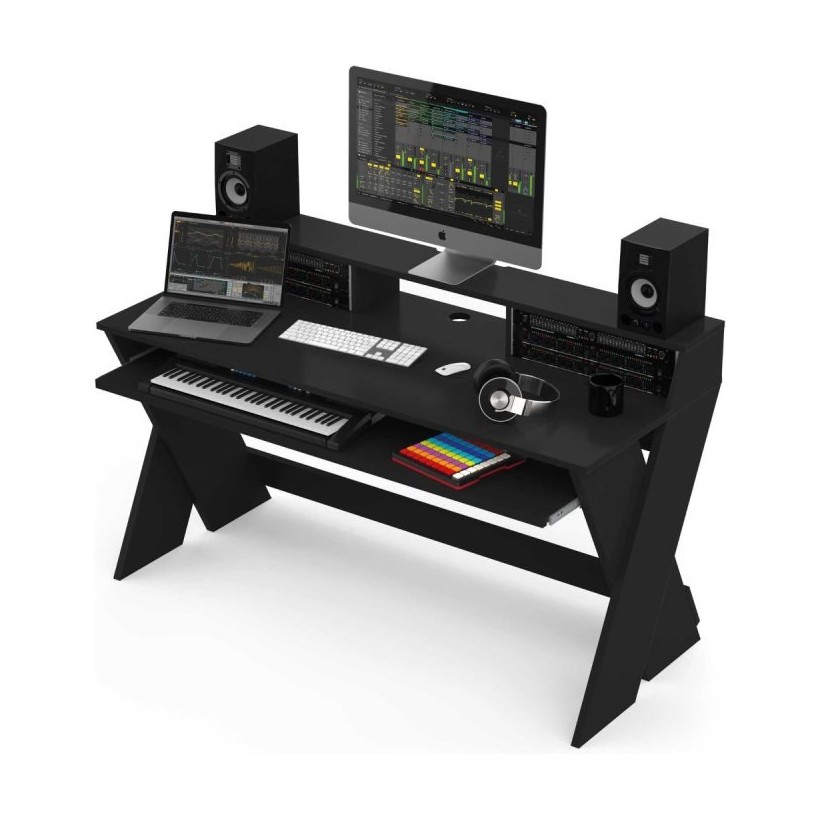
An 88-key keyboard on an ordinary desk takes the space where your mouse, laptop and coffee should be. The Sound Desk Pro gives it a drawer instead: a pull-out shelf 56.1 inches wide, at four heights, under a 61-inch desktop. Above it are a shelf for the speakers and screen, two 3U racks, a compartment for a laptop or interface, and cable ducts throughout, including one inside for a power strip.
It’s one of the best-loved studio desks around, as good a step up for a beginner moving on from a first desk as it is for a serious producer. Owners rate it well, and plenty report 88-key controllers fitting the drawer.
The catches: the drawer is rated for 12.5 kilos (about 27 pounds), 15 (33 pounds) at most. That suits a lighter 88, but hammer-action keyboards weigh more: the M-Audio Hammer 88 in our MIDI keyboard guide is 17.5 kilos (about 39 pounds). The desktop takes only 20 kilos (44 pounds), and one owner found a metal bar under it that costs the drawer about three-quarters of an inch of headroom. It weighs 87.5 pounds in two boxes, so line up a helper. And it isn’t on Amazon: nothing there with an 88-key tray had the reviews to match.
For a heavy hammer-action 88, use a sturdy keyboard stand in front of an ordinary desk, or step up to the Zaor Miza 88 XL Flex below, whose tray stands on its own legs and takes 40 kilos (88 pounds).
Best Studio Desk Under $2,500: Zaor Miza 88 XL Flex
Check the price at Zaor $2,199 when we checked
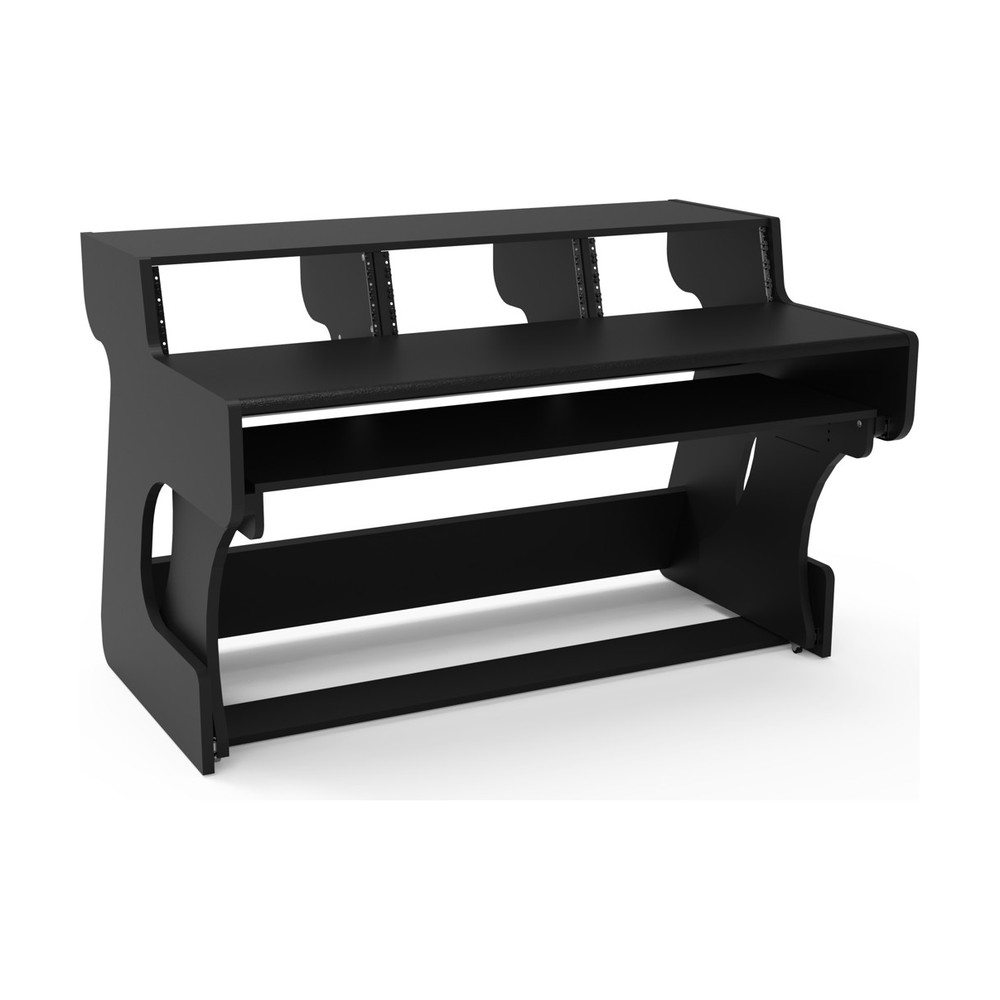
Past $1,000 you stop buying a desk for your gear and start buying the kind of furniture you see in professional studios: heavier, wider and built for a room you plan to stay in. Zaor makes a lot of those, and the Miza 88 XL Flex is the one we’d pick at this price, especially if a full-size keyboard is part of how you write.
The tray is the big difference. It slides out on its own wheeled legs that stand on the floor, so the keyboard’s weight never hangs from the desktop, and Zaor rates it for a keyboard up to 40 kilos (88 pounds) and 59.4 inches wide, at eight heights. That’s room for the heaviest hammer-action 88s. Above it sit 12U of rack space in three 4U bays, under a wide top shelf for the speakers and screen, with separate cable paths for audio and power. The older Miza 88XL it grew from was known for being sturdy and well engineered, with a cleverly designed keyboard shelf, and owners rate the Flex version highly too.
The catches: it’s laminated chipboard with solid wood trim, not solid wood, and it’s a big flat-pack of roughly 95 to 100 kilos (210 to 220 pounds) in two boxes, which owners say takes a few hours to build, so line up a helper. Some find the desktop a little high and the tray a little low. The black one is $2,199; the wood finishes cost $100 more.
If $2,000 is a hard limit, Zaor’s smaller Miza 88 Flex ($1,849) has the same idea with six rack spaces, but its tray is rated for 20 kilos (44 pounds). For a keyboard player’s studio that’s here to stay, the XL is the desk.
Best Studio Desk Under $5,000: Zaor Onda MKII Angled
Check the price at Zaor $3,199 when we checked
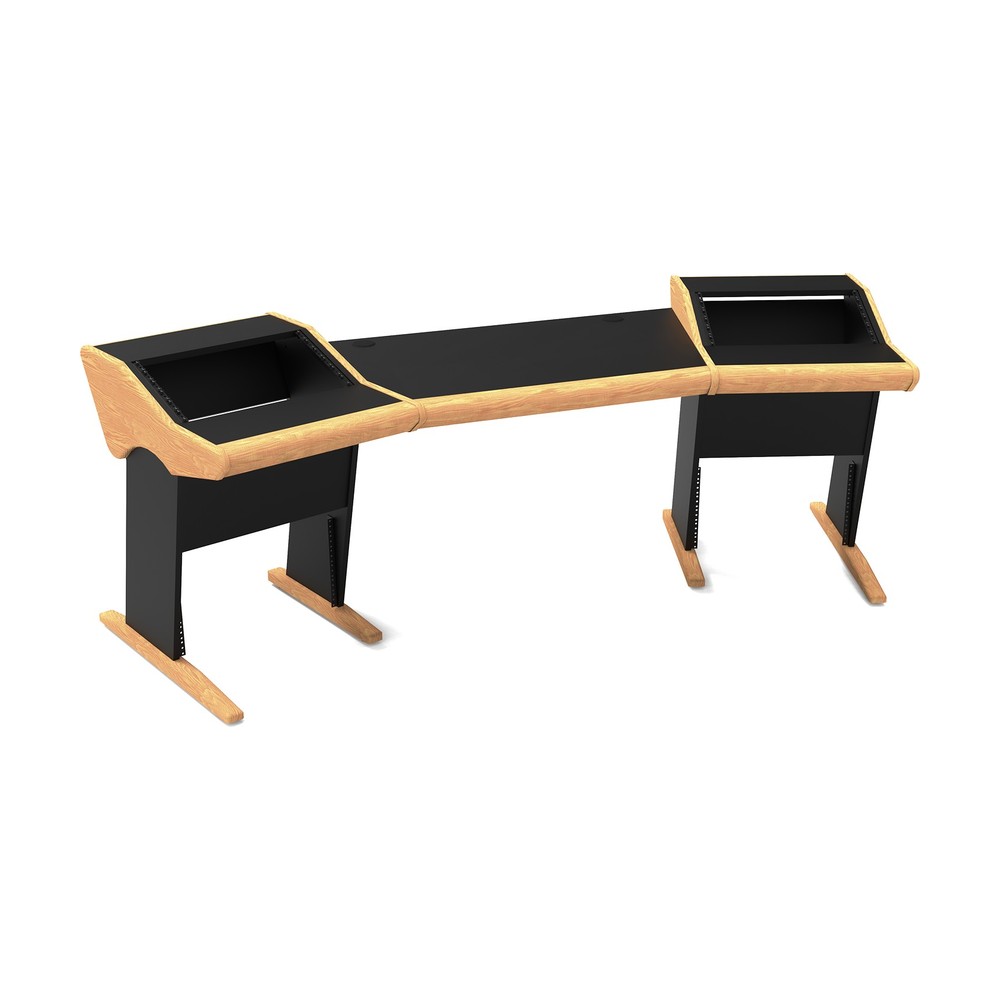
This is a desk for mixing more than playing. The Onda is a long, low workstation, 93.5 inches across, with an angled rack at each end of the desktop, 12U in all, tilted toward you so the gear you touch most is under your hands, and 12U more underneath for the boxes you set once and leave. Screens go on a lowered shelf at the back, out of the speakers’ way, and the middle is one big open surface for a controller, a small mixer or a keyboard and mouse. It’s the kind of desk you’d find in a professional mixing room, built in solid oak or ash, in five finishes.
The catches: there’s no keyboard tray, so a piano-style keyboard needs its own stand. At nearly eight feet wide it needs a long wall and room to walk around it, and once it’s built, it isn’t going anywhere. It’s a desk for a room built around it, not a corner of a bedroom. Keyboard players with this kind of budget should look at Zaor’s Miza X2 Flex ($3,749), the top of the Miza range, which keeps the floor-standing tray.
For a mixing room that looks the part, this is the one.
Setting up the desk you buy
Build it in the room where it will live, with a helper for the bigger ones, level it with its feet, and check the bolts again after the first week.
Put it against the wall, centered if you can, with the speakers on the top shelf near the back. A shelf still shakes along with the bass, so the pads or stands from our guide to setting up studio monitors on a desk still earn their place, along with its advice on spacing and angles.
Put the gear you touch most in the rack spaces nearest your hands, and run the cables before the gear goes in. Our guide to rackmounting studio gear covers the screws and units. And if the room still booms or rings once everything’s in place, no desk will fix that: Do You Need Acoustic Treatment? covers what does.
How we picked
Desks aren’t measured like speakers, so we read the guides, reviews and owners’ reports we could find for each desk, checked the makers’ dimensions, load limits, tray sizes and rack spaces, and checked US prices on November 7 and 8, 2026. A desk sold on Amazon got the spot wherever a good one earned it; the two Glorious desks come from music shops and the two Zaors from Zaor’s own US store, because nothing on Amazon matched them. We also looked at the Quik-Lok Z-250 (no rack space, and pricier than the Compact), the Studio RTA Producer Station (six feet wide), Output’s Platform (now sold by De-Fi from $999), the Argosy Halo (steel legs and 16U for $2,299.99, but no speaker shelves or 88-key tray in its base version) and, over $5,000, Sterling Modular’s Plan B and Plan C and Argosy’s Eclipse. We redo this guide every year.
Happy producing.