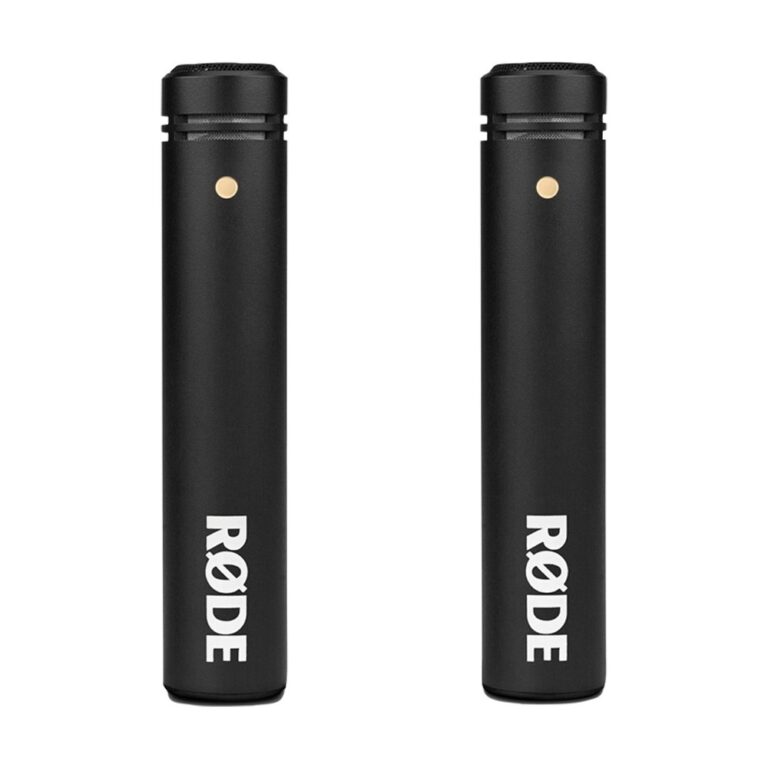
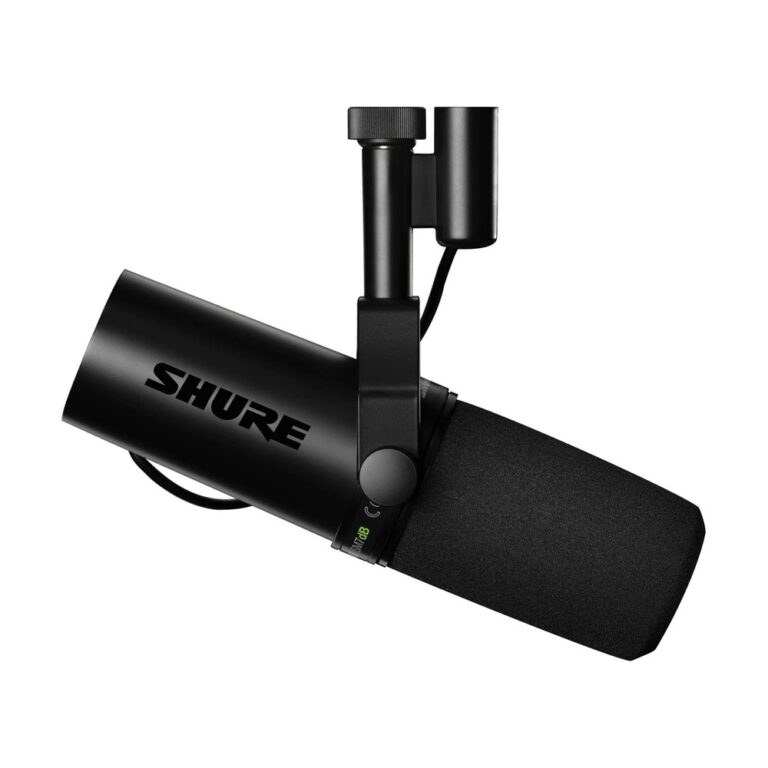
Turn a new mic over in your hands and somewhere on it, or on the box, is a little drawing: a circle, a heart, maybe a figure eight. If you bought a Blue Yeti or a multi-pattern condenser, there’s a switch with those same drawings on it, and it’s been sitting on whatever setting it came in. You’ve probably wondered whether that setting is the reason your recordings sound like they were made in a kitchen.
It might be. Those drawings are microphone polar patterns, and in a home studio they matter less for what the mic records than for what it doesn’t: the room, the computer fan, the person on the other side of the desk. Here’s what each one means, and which one to use.
What a polar pattern is
A polar pattern is a map of where a mic listens. Picture the mic from above, with its front facing you: the shape shows how loudly it hears a sound from each direction, the same sound played from the front, the sides and the back. Where the shape reaches far out, the mic hears well. Where it pulls in close, the mic hears less.
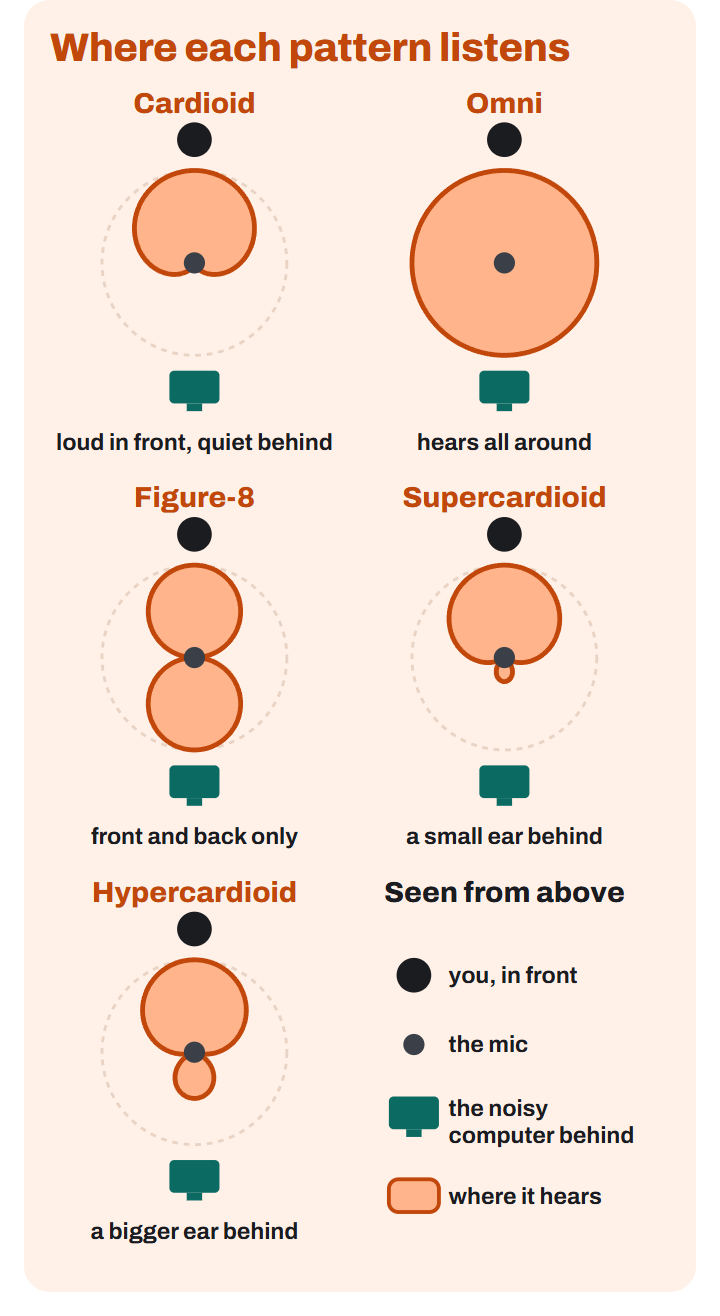
Every pattern is a trade between those two things. A mic can’t hear less of the room without hearing less of everything that isn’t straight in front of it, so the tighter the pattern, the more carefully you have to aim it, and the more your sound changes when you move.
One more thing the drawings don’t show: patterns aren’t perfect, and they change with pitch. Most directional mics get wider and rounder in the low notes and narrower in the highs. Treat the shapes as a good guide, not a promise.
Cardioid: the one you’ll use most
Look at almost any mic made for a home studio and you’ll find the same word on the box: cardioid. The name comes from the shape its pickup draws on a chart, a rounded heart with a dent at the back. In plain terms, a cardioid mic hears best what’s right in front of it, a little less from the sides, and least of all from directly behind.
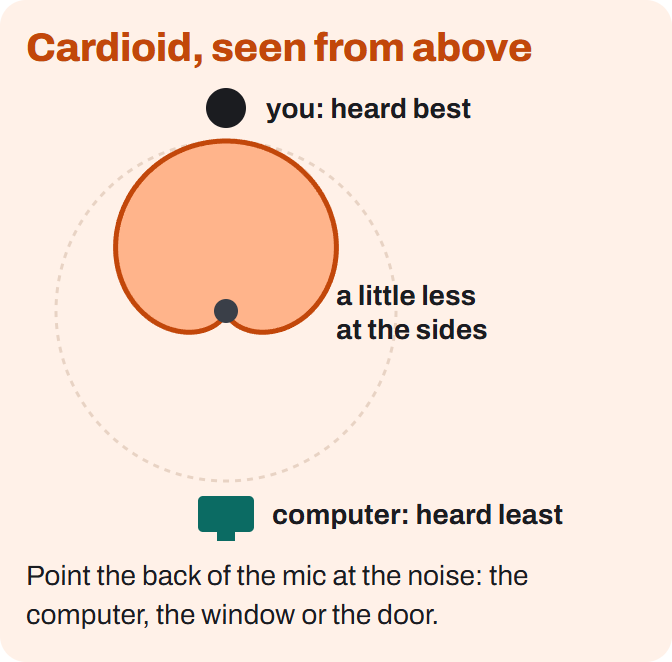
That last part is the useful bit. The back of a cardioid is the spot where it hears least, and in a home studio that’s where you want everything you don’t want to record. Turn the back of the mic toward your computer, the window or the door, and you turn all of them down at once, for free. Sing into the front, and your voice sits on top of it all.
It’s also why cardioid suits rooms nobody treated. It doesn’t make the room go away, mind you: the wall behind you still bounces your voice straight back into the front of the mic. But of the common patterns, it’s the one that forgives a so-so room the most, which is why it’s the standard choice for studios in rooms that aren’t ideal.
So if your mic has a switch and you’re recording one voice or one instrument, start on cardioid. You’ll rarely need to move it.
Omni: hears the whole room
An omnidirectional mic, omni for short, hears equally from every direction. Front, back, sides, ceiling: it doesn’t care where a sound comes from. That sounds like the opposite of useful, and in a bedroom with bare walls it mostly is. Every echo off the walls and every hum from the hallway comes in at the same level as your voice.
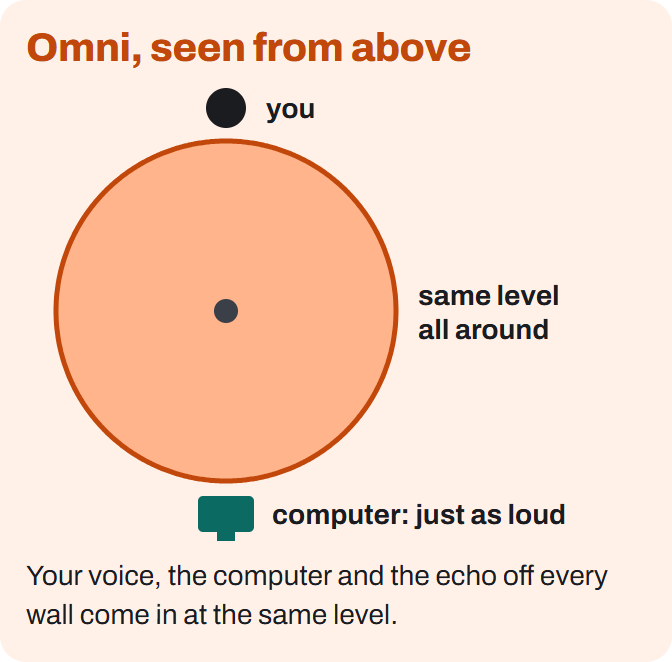
Which brings us to the Blue Yeti left on omni on the kitchen table. It hears the voice, the fridge, the dishwasher, the dog and the echo off the tiles, all in glorious detail, and the result sounds exactly like a kitchen.
In the right place, though, omni is lovely. In a room that sounds good, it captures the voice and the space around it in a natural, open way, with none of the tonal shifts directional mics have when you move. It’s the pattern for a group sitting around one mic, a choir, or the sound of a whole room. And as you’ll see below, it’s the only pattern that doesn’t get boomy when you get close.
Figure-8: front and back, nothing at the sides
A figure-8 mic, also called bidirectional, hears the front and the back equally well and almost nothing from the sides. Drawn from above, its pattern is two circles touching at the mic.
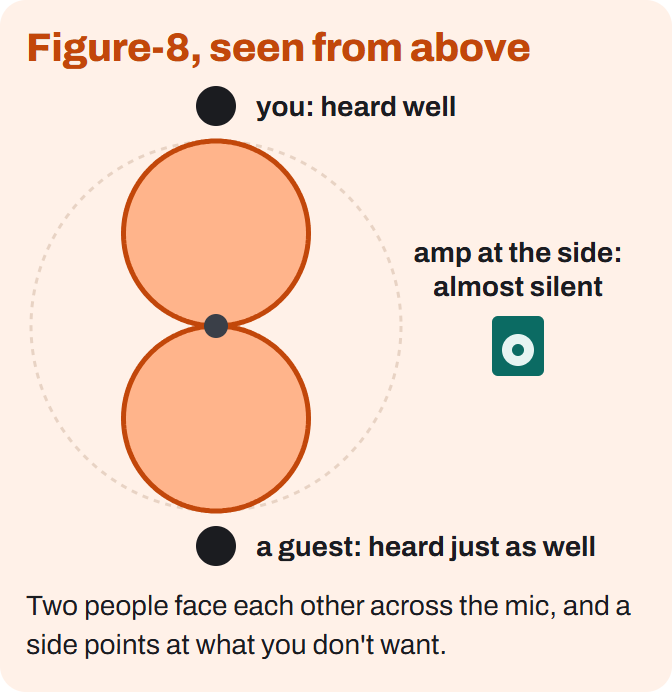
The obvious use is two people on one mic: put it between two singers, or a host and a guest, facing each other across it, and both get the same sound. The less obvious use is the sides. Because a figure-8 is nearly deaf at 90 degrees, you can point a side at the thing you don’t want, a guitar amp next to a singer, say, and it drops out more than it would on a cardioid’s side.
Figure-8 is also the natural pattern of most ribbon mics, and engineers use it in some stereo setups. For a solo voice in a bedroom, though, it’s a poor choice: the back hears the room just as loudly as the front hears you.
Super- and hypercardioid: tighter, with a little ear behind
Squeeze a cardioid narrower and you get a supercardioid, then a hypercardioid. Both hear less from the sides than a cardioid does, so they’re better at picking one voice out of a noisy space. The price is a small lobe of pickup straight behind the mic, a little ear at the back, which is bigger on the hypercardioid. Their quietest spots sit off to either side of the back instead of straight behind it.
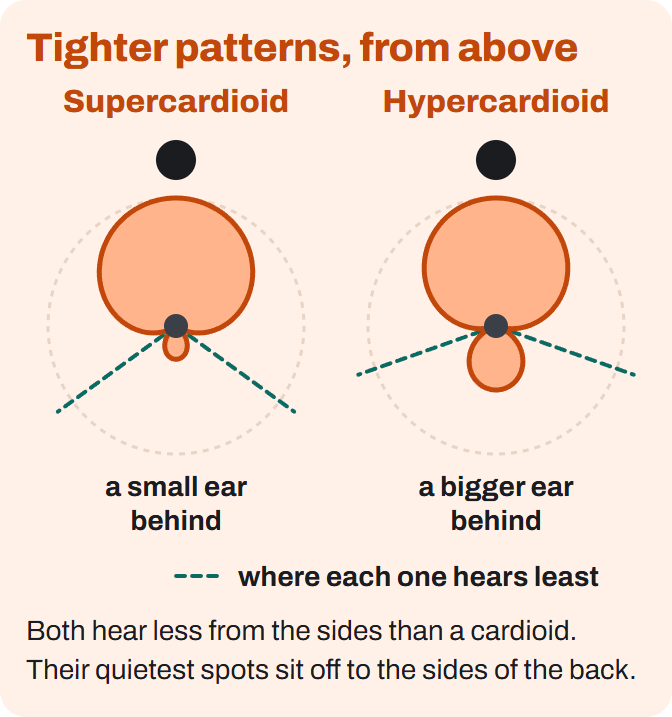
That shape is made for loud stages. A singer’s mic has to ignore the drums and the speakers pointed back at the band, and on stage those speakers are placed in the mic’s quiet spots. That’s why many stage vocal mics are supercardioid. In a bedroom, the narrow front mostly means your sound changes every time you turn your head, and the little ear at the back hears the wall behind the mic. Unless your room is loud, a cardioid is easier to live with.
Getting close: the proximity effect
Get your mouth right up to a cardioid and your voice gets deeper and warmer, like a late-night radio host’s. That’s the proximity effect: the closer you are, the more the bass builds up. It happens with every directional pattern, cardioid, figure-8, super and hyper, because of how those capsules work. A true omni mic doesn’t have it. Our explainer on the proximity effect goes into the why.
Used on purpose, it’s a nice trick, and it’s part of why voices on broadcast dynamics sound so big. By accident, it makes a vocal boomy and muddy, and the bass changes every time you lean in or back. The fix is simple: keep a steady distance, or turn on the mic’s low-cut switch if it has one. A pop filter helps with the first part, since it stops you creeping closer. Our guide to pop filters covers that, and the other thing that goes wrong up close.
Which setting on a multi-pattern mic
Some mics let you choose. USB mics like the Blue Yeti have a pattern knob, and a multi-pattern studio condenser has a switch on the body. Inside, they hold more than one capsule. A multi-pattern condenser usually has two diaphragms back to back, mixed in different amounts to make each shape.
On the Yeti, the knob has four settings: cardioid, omni, bidirectional (its word for figure-8) and stereo. For one person talking or singing, use cardioid, with the back of the mic toward the noise. Bidirectional for two people facing each other across the mic. Omni for a group around a table, in a quiet room. Stereo for an instrument or a room where you want width. That’s the whole knob.
So is a multi-pattern mic worth paying extra for? Only if you’ll really do those jobs: interviews and duets on one mic, a group, or recording a room. Most beginners never move the switch, and a good cardioid-only mic will sound as good or better for the same money. Our guide to the best condenser mics at every price has those. If you do want the switch, this is the one we’d start with.
If you want the switch: AKG P420
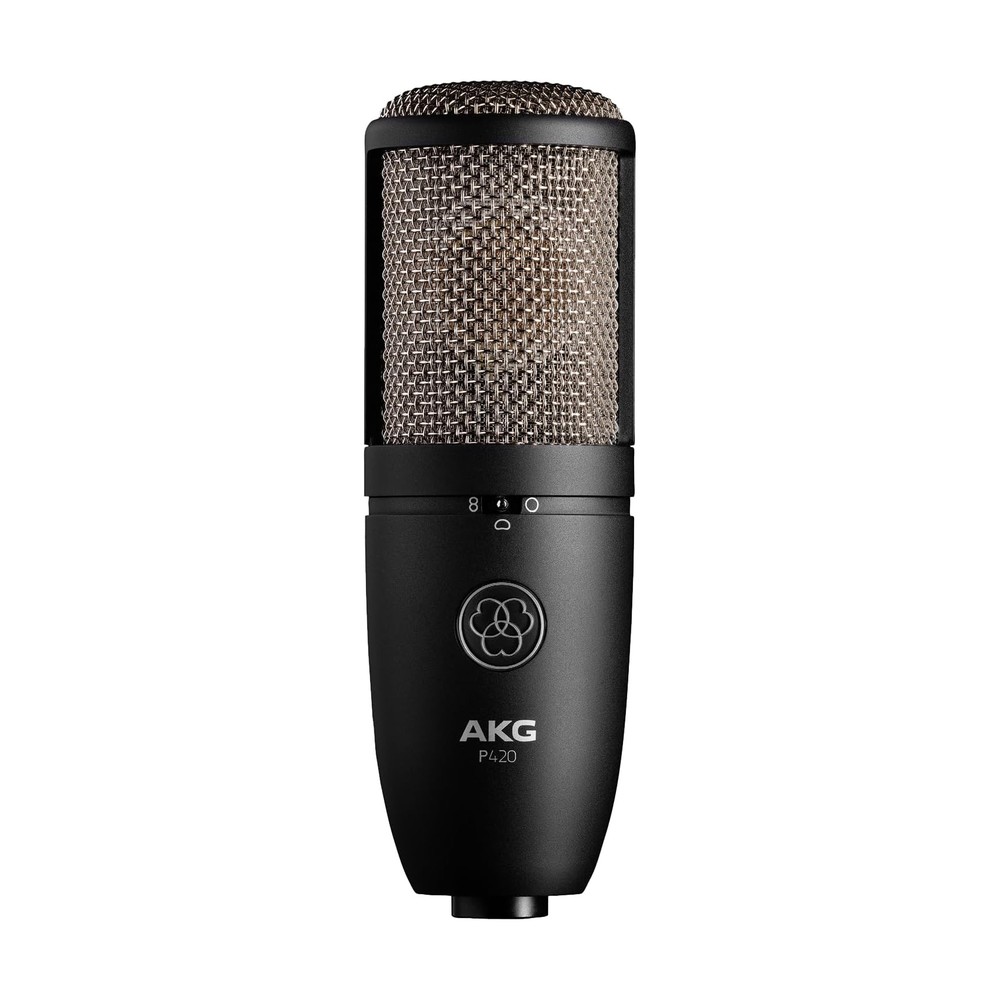
If you want a mic with the switch, this is the one we’d start with. The P420 has a one-inch capsule with two diaphragms back to back, and a three-way switch on the front for the three patterns that matter: cardioid, omni and figure-8. A pad for loud sources like drums or a guitar amp and a bass-cut switch are on the body too, and a shock mount and a case come in the box. It’s made by the same company as the C414, the classic multi-pattern studio mic we recommend in our C414 XLII review, at a small fraction of the price.
The catch: its sound leans a little bright, and its bass cut sits at 300 Hz, far higher than the usual 80 to 100, so on a voice it thins things out more than you’d want. Leave it off and cut the lows in your DAW instead. It’s heavy, too, so give it a sturdy stand. And as a plain cardioid mic for one voice, it’s no better than a good cardioid-only condenser at the same money. Regardless, if you’ll really record two people on one mic, a group or a room, it’s the best value we know of for getting all three patterns in one mic.
So, which one should you use?
For one voice or one instrument in a bedroom, cardioid, with its back pointed at the noise. Omni only in a room that sounds good, or for a group around one mic. Figure-8 for two people facing each other on one mic. Supercardioid for loud stages, not bedrooms. And whatever the pattern, the room still matters: if your recordings sound boxy, a little acoustic treatment will do more than any switch, and if the room is simply loud, our guide to dynamic vs condenser mics explains why a dynamic may be the better first mic.
Happy producing.