Shop for a first studio mic and you’ll see “large-diaphragm” on nearly every box under $300. Then you watch someone record an acoustic guitar, and the mic pointed at it is a skinny thing about the size of a fat marker, costing about the same. Now there seem to be two kinds of condenser, and half the forums agree you need both, which is a lot to be told before you’ve recorded a single song.
You don’t need both, not yet anyway. But large diaphragm vs small diaphragm isn’t just a line on the box. The difference is real, and once you know what it is, you’ll know which one your first condenser should be. It starts with a part of the mic you never see.
What the diaphragm is, and what counts as large
Inside the grille of every condenser mic is a capsule, and inside the capsule is the diaphragm: a very thin membrane, usually gold-coated, stretched just in front of a metal plate. Sound pushes it back and forth, and the mic turns that movement into a signal. “Large” and “small” describe that membrane, not the mic around it.
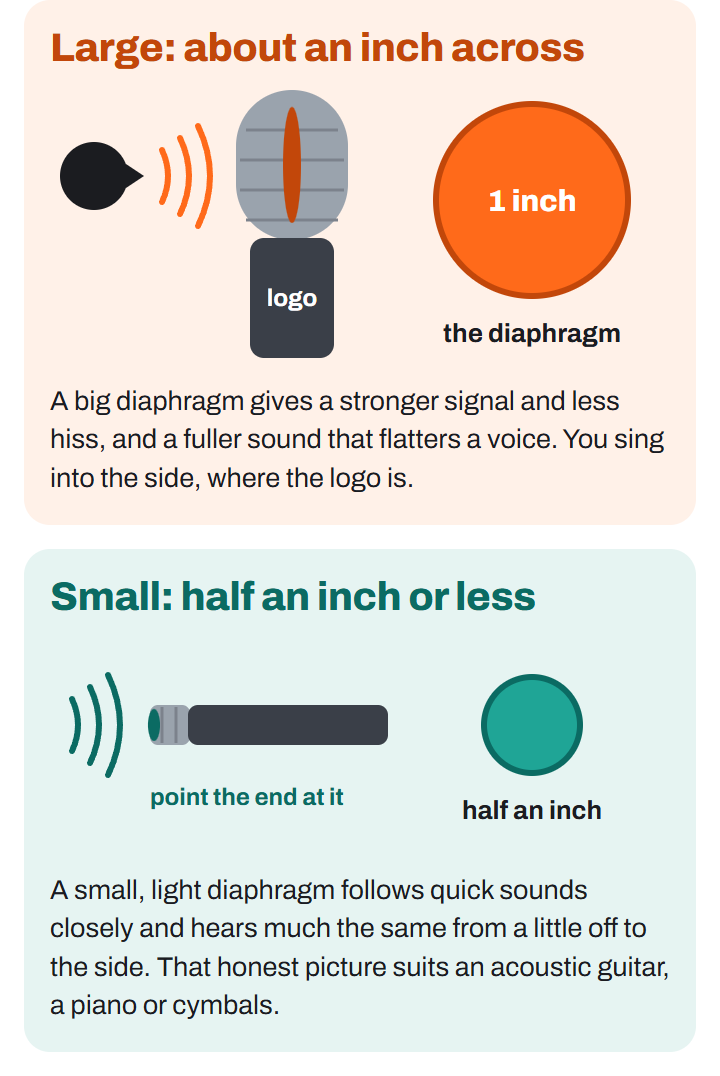
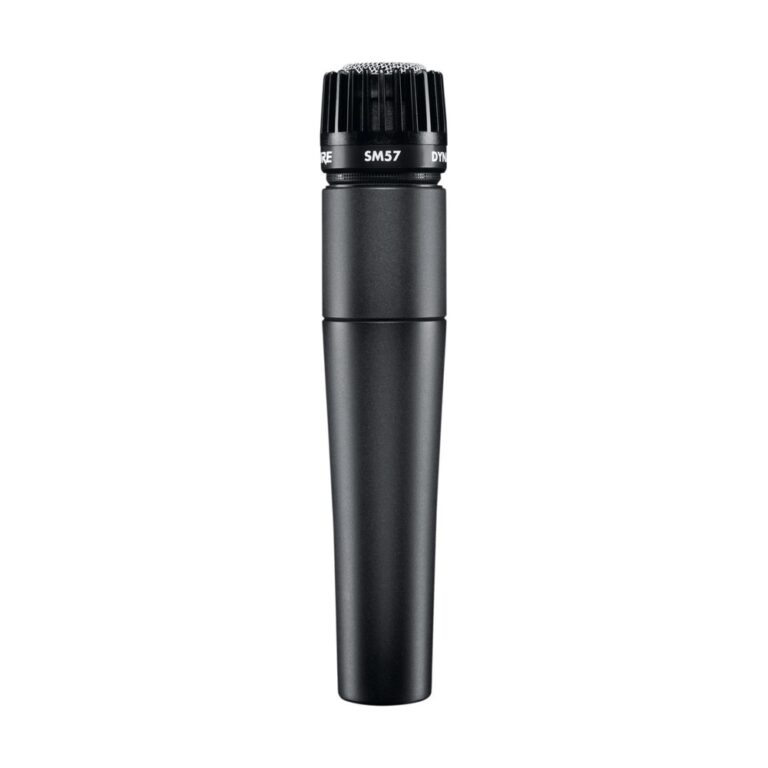
There’s no official rule, but the makers draw the lines in about the same place: large means a diaphragm about an inch across or more, small means half an inch or less. The words really only apply to condensers. A dynamic mic like the SM58 has a diaphragm too, but nobody sorts dynamics this way.
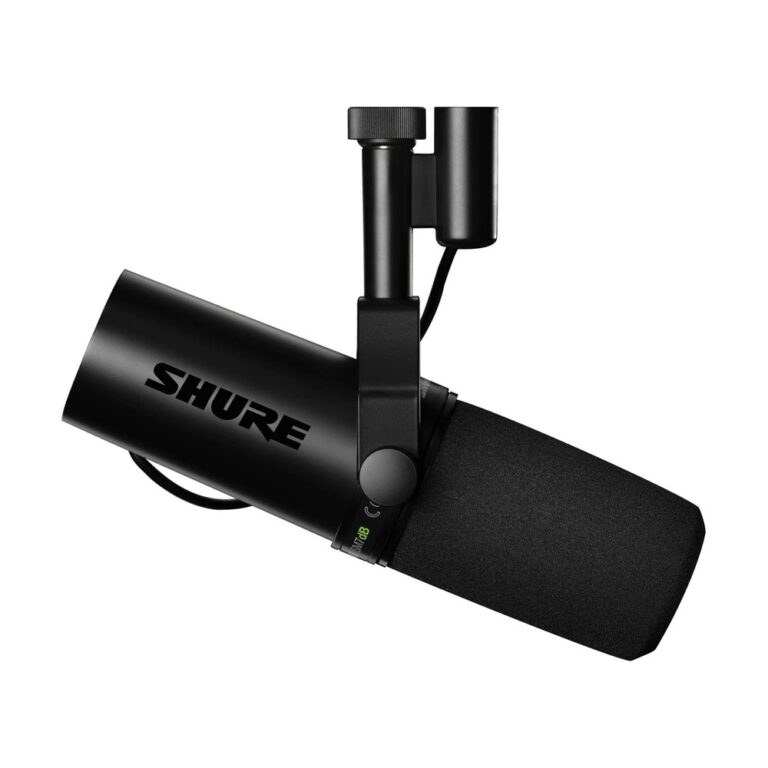
The shape of the mic usually gives it away. Large-diaphragm mics are side-address: the membrane stands upright in the head, so you sing into the side, the one with the logo on it. Small ones are end-address: the capsule sits at the tip of a slim tube, and you point the end at whatever you’re recording. Mixing those up is the classic first-day mistake. Sing into the top of a big condenser and you’re singing at the edge of the membrane, which is why the take comes out dull and distant.
Large diaphragm: the voice mic
A bigger membrane catches more of the sound, so it puts out a stronger signal for the same voice. Every condenser also adds a faint hiss of its own, called self-noise, and the stronger the signal, the further that hiss sits below what you’re recording. That’s the large diaphragm’s real technical advantage. On a quiet voice or a soft guitar part, you hear it as a cleaner, closer take with nothing fizzing underneath.
The other thing it brings is character. A big diaphragm doesn’t respond quite evenly to everything, and the result tends to sound fuller and a little more colorful than real life. On most voices that’s flattering: it’s a good part of the polished, up-front sound people mean when they say a vocal sounds like a record. It’s also why large-diaphragm mics are the usual choice for spoken word and podcasts, and why almost every condenser in our guide to the best condenser mics at every price is one.
The trade-off is direction. A big capsule keeps its proper pickup shape in the middle of the range, but it narrows in the highs and spreads out in the lows. Sing straight into the front of it and that doesn’t matter at all. Put it in front of something wide, like a piano, or record a player who moves around, and the tone shifts with the angle.
Small diaphragm: the honest one
Small-diaphragm mics are the skinny ones, shaped like a fat pen, and you point the end of them at what you’re recording. Inside is a capsule about half an inch across, half the width of the one in a big vocal mic. A smaller, lighter membrane has less to get moving, so it follows the sound more closely, and you hear that most on sounds that start fast: a pick hitting a string, a stick on a cymbal, the hammers of a piano.
They’re also steadier about direction. Neumann’s own charts make the point: its small KM 184 keeps the same cardioid shape from the low notes almost to the top of the range, while its famous large U 87 narrows in the highs and turns nearly omnidirectional in the bass. In plain terms, a small mic sounds much the same whether the guitar is right in front of it or a little off to one side, so a player who moves doesn’t change the tone of the take.
What you get is a plain, truthful picture, the sound people mean when they call a mic neutral. That’s exactly what an acoustic guitar wants, since it already sounds good and doesn’t need flattering. On a voice it can sound a little bare, which is why the singer usually gets the big mic.
Small mics also come in matched pairs, made to sound alike, and that’s the other thing they’re good at. Two of them over a drum kit, or one at the neck and one at the body of a guitar, give you a stereo picture. If you record acoustic instruments, a pair like that is often the second mic worth buying.
The sizes in between, and why the body doesn’t tell you
Here’s where the labels get slippery: the size of the body tells you very little about the size of the diaphragm. Audio-Technica’s AT2020 is a big, side-address mic that looks exactly like a large-diaphragm condenser and sits next to them on every shelf, but its diaphragm is 16 mm, about two-thirds of an inch. Some people call that medium. Most shops just file it under large.
It behaves somewhere in between, too, a little quicker and plainer than a full-inch capsule, which is part of why the AT2020 makes such a good all-rounder for the money. Plenty of other budget mics are built the same way: a big body around a smaller capsule. A big body is mostly just a big body.
So when you shop, look past the can and find the diaphragm size in the maker’s specs. If it says an inch, or 25 mm or more, it’s a true large-diaphragm mic. If it’s 16 to 20 mm, expect something in between.
Which to buy first, by what you record
Your voice, singing or rapping. Buy a large-diaphragm mic. It’s quieter and kinder to a voice, and it’s the mic nearly every home studio starts with. One caution first: a condenser of any size hears your room. If your bedroom is loud or echoey, read our guide to dynamic vs condenser mics before you buy, because a dynamic may make you better recordings, and a little acoustic treatment goes a long way either way.
Acoustic guitar. A small-diaphragm mic, six inches to a foot away, pointed at the 12th fret, where the neck meets the body on most guitars. Not straight at the sound hole, which mostly gives you boom. A pair gives you a wider, livelier picture, but one is plenty to start.
Piano. A matched pair of small mics, so the low and high strings come through in their own places. One large mic works on an upright if that’s what you have, though the tone will change as the player moves up and down the keys.
Drum overheads. A matched pair of small mics, a couple of feet above the cymbals. This is the job they’re best known for, since cymbals are all fast attack and fizzy top end.
Podcasts and voice-over. A large-diaphragm condenser in a quiet room, or a dynamic in a noisy one. If you’re still choosing how it connects, our USB vs XLR guide sorts that out.
A bit of everything. One large-diaphragm mic first, then a small pair when you start recording instruments. That’s the order most home studios grow in, and neither one is better than the other: they’re good at different things.
For your voice: RØDE NT1 Signature Series
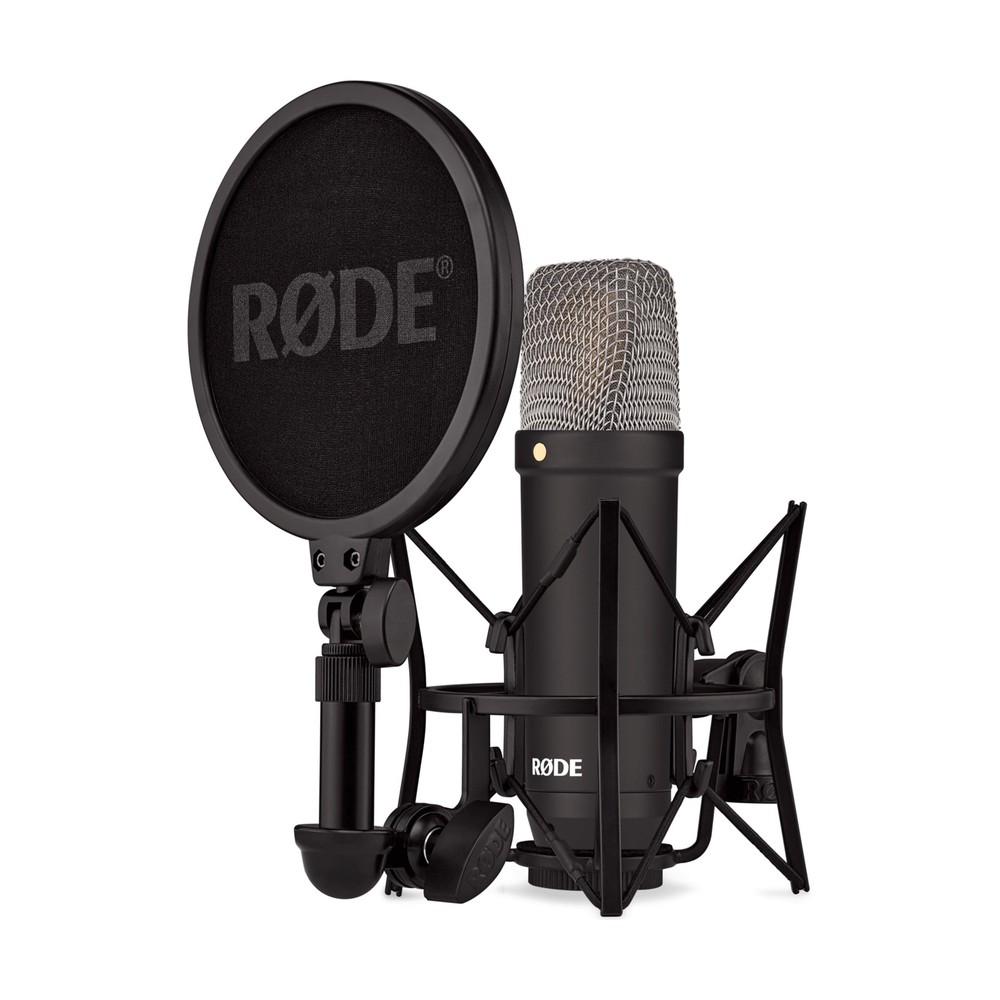
If your first condenser is for your voice, this is the one we’d buy, and it’s our pick under $200 in the condenser guide. It has a full one-inch capsule and it’s remarkably quiet, quieter than mics costing several times as much, so soft passages come through clean. It comes with a shock mount, a pop filter and an XLR cable, which covers most of what you need to start.
The catch: its top end is on the bright side. On a voice that already has sharp S’s, plan on a de-esser, or angle the mic slightly off your mouth. There’s no pad or low-cut switch, either. Regardless, for a first vocal condenser it’s the best value we know, and nothing near its price is as quiet.
For guitar and piano: RØDE M5 matched pair
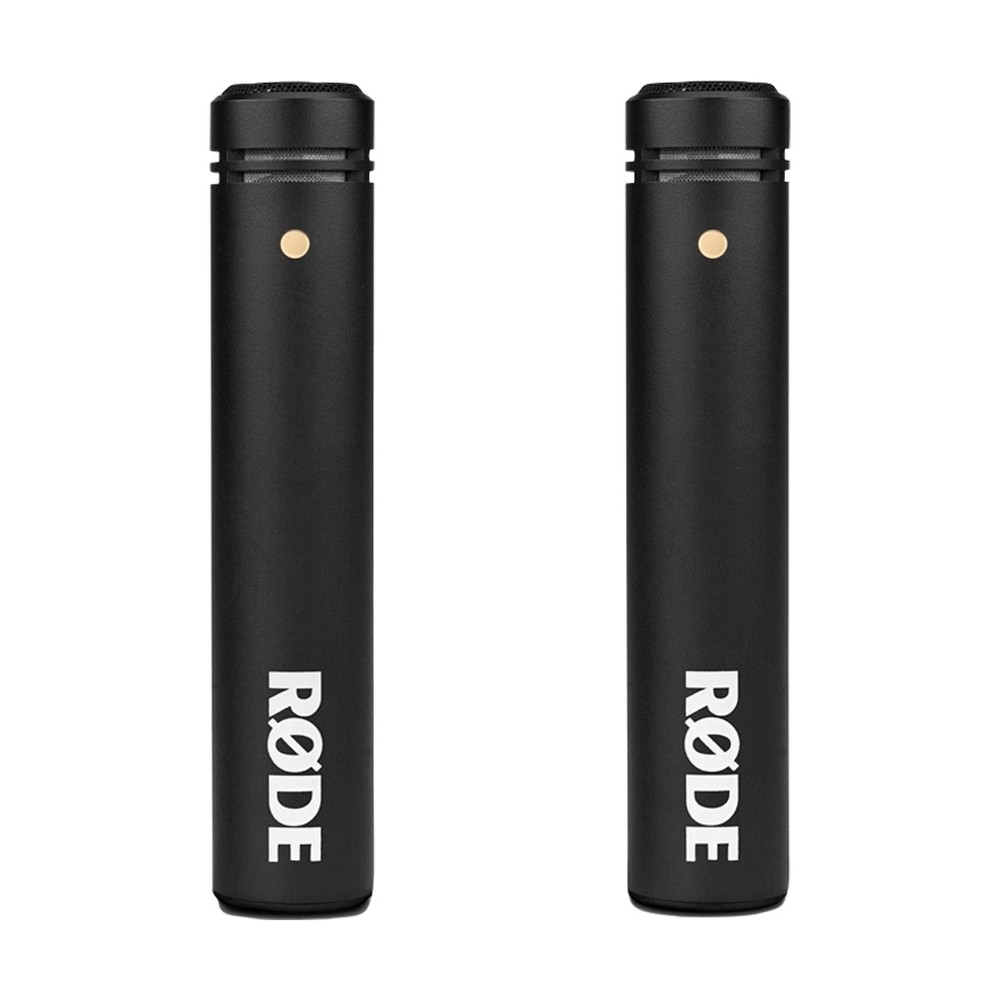
For a first pair of small-diaphragm mics, the M5 is the easy recommendation. You get two half-inch cardioid condensers, matched at the factory to sound alike, with foam windshields and stand mounts in the box, for not much more than one decent vocal mic. That’s a stereo pair for acoustic guitar, piano or drum overheads, ready to go.
The catch: it’s noisier than the NT1, as small capsules at this price tend to be. On a loud source like drums or a strummed guitar you’ll never hear it; on a whisper-quiet fingerpicked part, close up, you might. Don’t buy it as your vocal mic either, for the reasons above. But as the second purchase in a home studio, nothing near its price does the job as well.
So, large or small?
If your first condenser is mostly for your voice, buy a large-diaphragm mic. If you mostly record acoustic guitar, piano or a drum kit’s cymbals, a small-diaphragm mic is the better tool, ideally a matched pair. Neither is the better mic overall. Most home studios that keep growing end up with one big mic and a pair of small ones, in that order, and whichever you start with, it’s worth putting a pop filter in front of anything you sing into.
Happy producing.